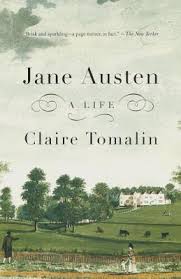
The first classic I read was Jane Austen ‘ s Pride & Prejudice . I followed it up with Persuasion a year or so later I guess – with these two titles I wrapped up my Austen reads ( that is going to change now BTW ) . And after a very long time , I picked up something Austen – a biography of Jane Austen by Claire Tomalin .
It reads like as if Claire has discovered a time portal through which she takes the reader to the Steventon rectory where Austen spent the greater part of her life. The life and times of the Austen household evolve before the reader’s mind’s eyes .
The Austen Home :
Jane Austen was born as the seventh among eight children to George Austen & Cassandra Leigh – Austen in the rectory at Steventon , where George Austen was the clergyman . For easily recognizing of the names referred in this post hereafter , a little list of the Austen siblings – James , George , Edward , Henry , Cassandra , Francis , Jane & Charles .
Tomalin packs in quite a lot in the narrative about the Austens ‘ rural world – she offers insightful comments about the Austen household aspects which might have shaped Jane as a person & her opinions on certain subjects :
- how the Austen children ‘s childhood in foster homes during infancy might have contributed to the emotional distance of Mrs . Austen and Jane which is very well evident in her adult letters ( they came back to the Austen household once they reached the ‘ age of reason ‘ – Claire says that it was a common practice in those days and the absent babies were visited quite often and were brought home to Steventon regularly ) . Tomalin observes :
The most striking aspect of Jane ‘s adult letters is their defensiveness . They lack tenderness towards herself as much as towards others . You are aware of the inner creature , deeply responsive and alive , but mostly you are faced with the hard shell ; and sometimes a claw is put out , and a sharp nip is given to whatever offends . They are the letters of someone who does not open her heart ; and in the adult who avoids intimacy you sense the child who was uncertain where to expect love or to look for security , and armoured herself against rejection .
- One of her juvenilia , titled Lesley Castle featured an adulterous elopement by a young mother who abandons her young baby and her husband who converts to Catholicism to procure an annulment . Eventually , both the parties are remarried happily . For the daughter of a clergyman , these are quite daring but George Austen ‘ was an exceptional father to his exceptional daughter ‘ who allowed unreined imagination in his daughter and clearly put up with some daring content in an easy manner . His graceful tribute for young Jane ‘s juvenilia at the front of her notebook is the testimony to his support and encouragement of her promising talent : Effusions of Fancy by a very Young Lady Consisting of Tales in a style entirely new ‘ . He gave her uncensored access to his library which led to Jane reading some adult work at a young age like Sir Charles Grandison by Richardson . Charlotte Grandison , one of the titular character ‘s two sisters , Tomalin surmises , should be the early inspiration for Elizabeth Bennet .
- If George Austen offered encouragement , Cassandra Leigh – Austen very clearly is the contributor of the literary talent among the Austen children . She wrote light verse in her spare time . Both James and Jane produced poems quite often .
Mrs . Austen ‘s Dialogue between Death & Mrs . Austen
Says Death , ‘ I ‘ ve been trying these three weeks or more
To seize an old Madam here at Number Four ,
Yet still I try in vain , tho’ she ‘ s turned of three score ;
To what is my ill-success owing ? ‘
‘ I ‘ll tell you , old Fellow , if you cannot guess ,
To what you ‘ re indebted for your ill success –
To the prayers of my husband , whose love I possess ,
To the care of my daughters , whom heaven will bless ,
To the skill and attention of Bowen *.
[ Bowen is her doctor ]
And here is one from Jane [ written in the tone of her niece Fanny on the occasion of her brother Francis ‘ wedding describing the arrival of the pair at Fanny ‘s house ]
Down the hill they’re swiftly proceeding
Now they skirt the Park around ;
Lo ! The Cattle sweetly feeding
Scamper , startled at the sound !
Run my brothers , to the Pier gate !
Throw it open , very wide !
Let it not be said we are late
In welcoming my Uncle ‘s Bride !
To the house the chaise advances ;
Now it stops – They ‘ re here , they ‘re here !
How d ‘ ye do , my Uncle Francis ?
How does do your Lady dear ?
It ‘ s not very surprising , as you can see , after reading Mrs . Austen ‘ s witty one , that Jane can actually write poems too .
- how the quite dismal school life of the Austen girls might have contributed to the not-very-great ( at times scornful & at times pitying ) opinion about the teaching profession and governesses : ” To be rational in anything is great praise , especially in the ignorant class of school mistresses ‘ .
The REAL Jane :
But the thing which thrilled me the most was the character study of Jane Austen which introduced an entirely different person from what the mythographers have led the public to believe for too long . Her paternal aunt observes :
Jane was ‘ whimsical and affected ‘ , ‘ not at all pretty or feminine ‘ , ‘ very like her brother Henry ‘ , ‘ very prim ‘ – this establishes that perhaps Jane did not tick the checkboxes for a ‘ proper ‘ girl . Her nephew / mythographer / first biographer James – Edward in her Memoir says :
‘ very attractive . . . a clear brunette with a rich color . . . full round cheeks with mouth and nose small and well formed , bright hazel eyes , and brown hair forming natural curls close round her face . . . no so regularly handsome ‘
Perhaps , it is the roundabout way of saying that Jane was not considered beautiful . He further adds ,
‘ she and her sister were generally thought to have taken to the garb of middle age earlier than their years or their looks required ; and . . . were scarcely sufficiently regardful of the fashionable , or the becoming ‘
Jane herself says : ‘ My hair was at least tidy , which was all my ambition ‘ which confirms her nephew ‘ s comments . In one of her letters , Jane writes to Cassandra that she was trimming a dress with ribbon – ‘ With this addition it will be a very useful gown , happy to go anywhere ‘ . The telling phrase happy -to -go – anywhere should be an indicator of the priority Jane accorded to fashion .
Her niece Fanny observes in her personal diary ( in her seventies ) thus :
was not so refined as she ought to been from her talent . . .They [ the Austens ] were not rich & the people around with whom they chiefly mixed , were not all high bred , or in short anything more than mediocre & they of course tho ‘ superior in mental powers & cultivation were on the same level as far as refinement goes . . . Aunt Jane was too clever not to put aside all possible signs of ‘ common -ness ‘ ( if such an expression is allowable ) & teach herself to be more refined . . . Both the Aunts [ Cassandra & Jane ] were brought up in the most complete ignorance of the World & its ways ( I mean as to fashion & c ) & if it not had been for Papa ‘ s [ Edward Austen ‘s ] marriage which brought them into Kent . . . they would have been tho ‘ not less clever and agreeable in themselves , very much below par as to good Society and its ways .
Of course , Fanny Austen ‘s diary entry enraged the Jane Austen fans but they must be thankful that they got the true picture rather than the goodwill and the bland portrayal in consequence to her posthumous fame like the memories of her brother Henry Austen or the part-biography & part-mythography from her nephew James – Edward .
Another niece , Anna [ James Austen ‘s daughter ] observes regarding Mrs . Edward Austen ‘s preference to Cassandra thus :
‘ A little talent went a long way with the Goodnestone Bridgeses of that period , & much must have gone a long way too far ‘ .
Perhaps , that must have been the general opinion about Austens but the general public has always been dished out a florid account of the family and most particularly Jane .
Then there is another memory recounted by Anna :
I recollect the frequent visits of my two Aunts , & how they walked in wintry weather through the sloppy lane between Steventon & Dean in pattens , usually worn at that time even by Gentlewomen . I remember too their bonnets : because though precisely alike in color , shape and material , I made it a pleasure to guess , & I believe always guessed right , which bonnet & which Aunt belonged to each other .
Tomalin adds her own keen observations to Anna ‘ s recollection :
There is something depressing about the choice of identical bonnets for women in their mid – twenties , almost as though they were signalling that they were indifferent to establishing any individual style .
It is this drawing of the reader ‘s attention to the seemingly insignificant things that might reveal something truly significant on closer observation that I loved in Claire Tomalin ‘ s biography . Of course , it is a well – known fact that she shared a close bond with her sister Cassandra who described Jane lovingly , after her death thus :
She was the sun of my life , the guilder of every pleasure , the soother of every sorrow . I had not a thought concealed from her , & it is as if I had lost a part of myself .
Cassandra
Her parents had correctly predicted Jane as ‘ a present plaything for her sister Cassy and a future companion ‘ . The phrase ‘ present plaything ‘ brings to mind Anne Frank ‘ s lines : ” I was plonked on the table as a birthday present for Margot ” . Surely , the role of the younger sister hasn’t changed a bit through several centuries .
Cassandra and Jane wrote to each other continuously , when one of them happened to be travelling . It reminds one of Elizabeth ‘ s letters to Jane in Pride & Prejudice when she had gone to Charlotte Collins ‘ home on a short visit . The reader need not be too clever to draw such little parallels between Jane herself and her characters .
Cassandra , unfortunately , never recovered after the death of her fiancee` and never took another chance at romance and marriage . Tomalin observes thus :
[ . . . ] there is something disquieting about a once cheerful , pretty girl who elects the role of a virgin widow in her early twenties , so certain that she will never recover from the loss of one lover that she rejects youth and its pleasures in favor of melancholy and self – effacement .
After Jane Austen ‘s death , Cassandra , ‘ reproached herself for having loved her so much , accepting that God had punished her for such exclusiveness ‘ . Cassandra ‘ s words are , ” I can acknowledge . . . the justice of the hand which has struck this blow ” . This is understandable , considering that she had lost her one true love earlier and now a much loved younger sister .
Perhaps , Jane voluntarily joined Cassandra , in her spinsterhood ( ? ? ) . [ This is a my little idea – after all , when Cassandra was engaged , Jane too had her own little romances . . . ]
Jane ‘ s romances :
Jane might have joined Cassandra with the passage of time or perhaps , as speculated in the previous section , joined her beloved sister in spinsterhood voluntarily . However , that does not mean that Jane did not have any romances . She had a romantic attachment to a Tom Lefroy when she was twenty . Tomalin summarizes her romance with Lefroy thus :
‘ Tom Lefroy , [ is ] her ‘ Irish friend ‘ with whom she enjoyed behaving outrageously at a dance . He was a law student from Ireland , a holiday visitor to his uncle in Hampshire and , at just twenty , the same age as her . He was also financially dependent on the goodwill of another uncle and since neither he nor Jane had a penny , an engagement between them was out of question ; when it become obvious that they were falling in love he was smartly sent away Jane joked about him , but it was a painful experience , and she was still thinking of him three years later . [ . . . ] As a very old man he acknowledged , when questioned , that he had loved Jane Austen in 1796 . ‘
Jane accepted a proposal from her friends ‘ brother Harris Biggs , the heir of a gentry family , the Biggs , while she was on a visit to the Bigg family home . She accepted him in the evening , but changed her mind during the night . Who knows what thoughts criss-crossed her mind that led to such a decision ? Perhaps Cassandra too was a major factor in influencing her decision ( this is basically my observation in conclusion of what had been said in the previous passages – any takers ? )
A quick overview :
Then , there is the establishing of the Steventon parsonage neighborhood and the society in which Jane might have moved . We also get to see the diary entries from one of the neighbors & occasionally her nieces ‘ recollections , Jane ‘ s letters – all of these provide us a wealth of information about her social life when Tomalin guides the reader in studying every sentiment and incident mentioned there . Then , there are the neighborhood family histories which the biographer has managed to unearth – all these only allow us to visualize a wider geography of the Steventon neighborhood with great clarity . And we are introduced to the people whom she might have met during her travels to Bath / Kent ( her brother Edward Austen ‘s manor ) .
We also come to the conclusion along with Tomalin on some of her real – people or literary inspirations for her characters – Tomalin follows every single surmise or argument with solid proof that the reader has no hesitation in accepting her theory . Imagine the rude surprise to a lady who discovered that Lady Bertram from Mansfield Park has been based on her , who , Tomalin observes ‘ is virtually an imbecile ‘ . The books she might have read and courtesy whom and which characters in these books are the inspirations for her characters are solidly established that the reader can easily agree with her . The ideas , themes and the style of these books are also explored in detail to establish the connections between her books and the books she read . Of course , there is a parallel study between her heroines and the detailed exposition of every plot- line and theme of Jane ‘ s books . The timeline during which she might have written the original manuscript and the possible family – events and situations which might have made its way into the themes and the plot – line are analyzed in great detail .
For fans of Mansfield Park , there is a separate chapter dedicated for the analysis of the themes & the plot line and also in analyzing the political scenario at that time . Tomalin opines that Mansfield Park was ‘ prophetic ‘ : in a sense , Fanny Price and Queen Victoria eventually get rewarded for holding on to their moral values despite all the corruption and strife around them ( That is really a very interesting idea !! )
The explanation for the cropped hair of both Francis & Charles Austen shows the league in which Tomalin operates – nothing is too small a detail to be ignored. Who else would have given a second thought to the brothers ‘ hairstyles ? Very few , with a rare thought process , of seeing the huge implication of a subtle thing that can be easily missed out . Claire Tomalin has drawn the reader ‘ s attention to several such little things and has shown the bigger things like the political climate lying beneath . This is yet another aspect which I loved about Claire Tomalin ‘ s writing .
[ . . . ] the Prime Minister Pitt , recommended the poor to eat meat instead of bread and the price of which simply kept rising, with disastrous consequences for those who depended on it . Pitt’s advice sounds like Marie Antoinette’s …. Pitt decided to raise money from the middle classes by putting an individual tax on hair powder : the result was effectively to end it’s use . A few held out like Edward and Elizabeth ( Edward ‘s wife ) Austen- and no doubt George Austen continued to wear his old fashioned powdered wig – but more followed Francis and Charles, who simply had their dark hair cropped short. The result is that they both look entirely modern in their portraits, inhabitants of a different world from their brothers James and Edward, who were both immortalized as men of an ancien regime .
The readers & particularly , Jane Austen fans are lucky to have such a biographer for Jane Austen . Claire herself acknowledges the difficulty of investigating the private life of an author such as Jane Austen , who wrote no autobiographies / had no surviving relations who had preserved her letters and personal diaries ( if there are any ) . Cassandra destroyed almost all her letters from Jane 2 or 3 years before her death . The letters which she gave her nieces as legacies had several portions cut out ( according to one niece , Caroline Austen ) . Her brother Henry Austen ‘ s epitaph omits the fact that she was a successful authoress ( !!! ) . It reads thus :
In Memory of
JANE AUSTEN
youngest daughter of the late
Revd GEORGE AUSTEN
formerly Rector of Steventon in this County
she departed this life on the 18th July 1817 ,
aged 41 , after a long illness supported with
the patience and the hopes of a Christian .
The benevolence of her heart ,
The sweetness of her temper , and
the extraordinary endowments of her mind
obtained the regard of all who knew her and
the warmest love of her intimate connections .
But , we need to thank Henry for enabling the publishing Northanger Abbey & Persuasion together , posthumously . He always maintained ” my dear Sister ‘ s life was not a life of Events . . . Nothing like a journal of her actions or a conversation was kept by her or others . Indeed the farthest thing from her expectations or wishes was to be exhibited as a public character under any circumstances ” ( Maybe . . . ) . The memoir by the nephew recounts Jane Austen as a ‘ gentle , cheerful , domestic woman , whose writing was essentially an amateur activity ‘ which was loved by the public of the Victorian era .
But now , thanks to Claire Tomalin , we have a fairly accurate picture of the life of Jane Austen . Highly recommended from me !!! For every Jane Austen fan , this book should be a must read . . . I only wish that Claire Tomalin had written the Bronte sisters ‘ biography too ( the idea of a biography of three literary giants in a single book is really very exciting . . . )
If you had picked up the book , let me know in the comments section what YOU thought about the book . Also , feel free to share your thoughts about this post .
Until the next review then . . . And , thanks for your patience to read through this entire post .
For readers from India , you can purchase the book here .
[ This is an amazon affiliate link and I may receive a small commission for your purchase from this link without any additional cost to you ] .
 Plot Summary :
 On Books,Movies and other Random stuff that make my Day